How Do Practical Assessments Work in an Online Personal Training Course?
One of the first questions people ask about studying fitness online is a sensible one: if the course is online, how do you prove that you can actually coach and demonstrate exercises?
Published by Online Personal Training Institute | RTO 46231
Fitness qualifications still require practical competency
A fitness qualification is not designed to be completed by reading theory alone.
Personal trainers and fitness instructors work directly with people. They demonstrate exercises, observe technique, communicate instructions, conduct fitness related activities and make decisions in practical environments.
For that reason, practical assessment is an important part of completing the SIS30321 Certificate III in Fitness and SIS40221 Certificate IV in Fitness.
Theory and practical assessment are different parts of the course
At Online Personal Training Institute, theory assessments are completed online through the student portal and primarily include multiple choice and short answer questions supported by learner guides.
Practical assessments require students to demonstrate specified skills and tasks.
Keeping those two components separate is important. Theory helps establish what you understand. Practical evidence shows that you can apply relevant skills in an appropriate setting.
Option 1: film your practical demonstrations
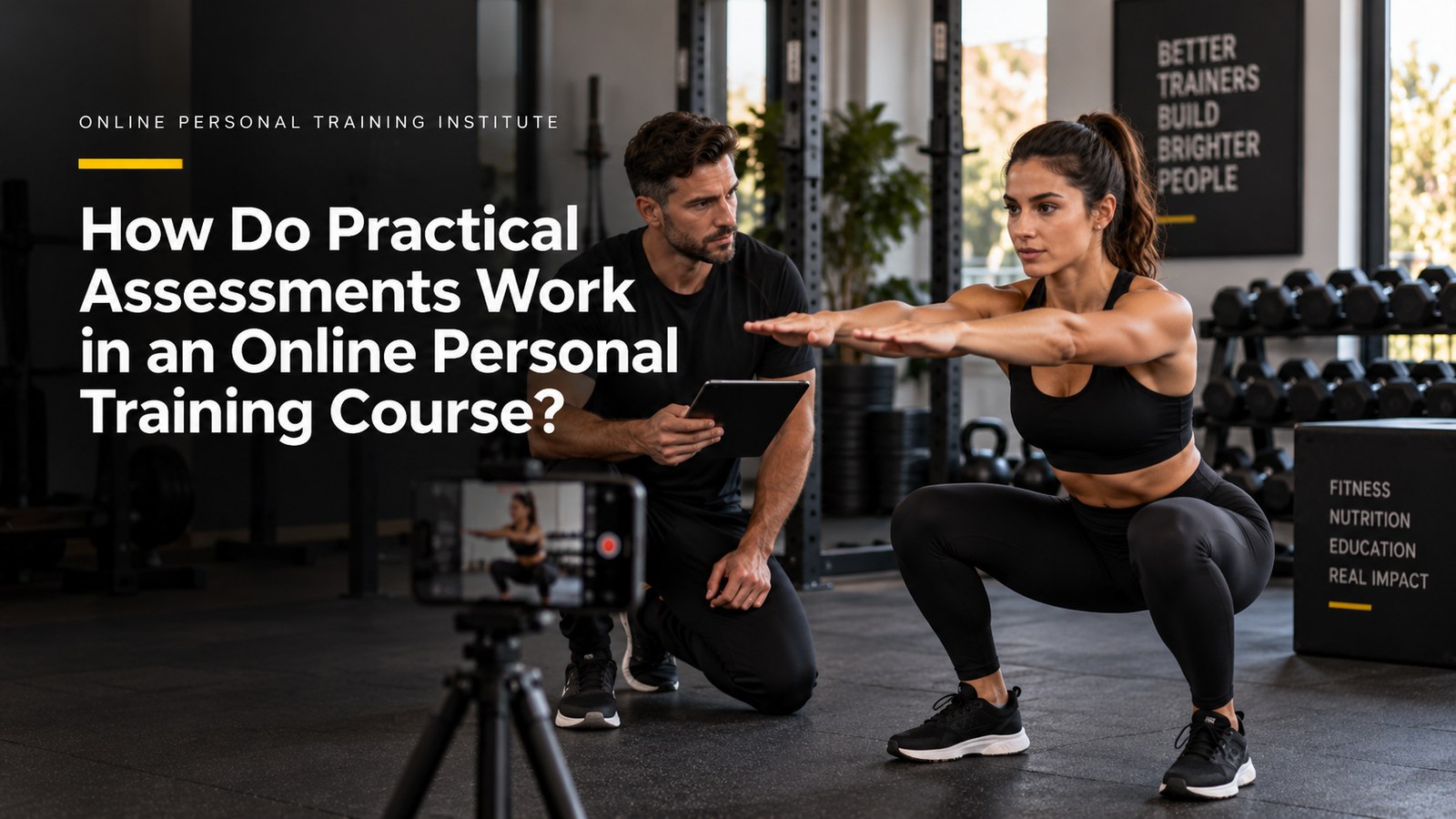
One available pathway is to film yourself completing the required practical exercises and tasks, then upload the videos through the student portal for assessment.
For many online students, this approach provides useful flexibility because filming can be organised around access to a suitable location, equipment and participants.
The key is not simply creating a fitness video. The recording needs to clearly demonstrate the assessment requirements so the qualified assessor can make an evidence based assessment decision.
Option 2: complete practical tasks with a workplace mentor
Students may also choose an eligible workplace mentor to observe them completing practical assessments.
Under OPTI’s current assessment model, the workplace mentor must hold both the SIS30321 Certificate III in Fitness and SIS40221 Certificate IV in Fitness, and practical assessments must be completed in a safe and suitable fitness facility.
The mentor completes the required observation documentation, which is then reviewed by OPTI’s qualified trainers and assessors. The final assessment decision remains with the RTO assessor.
You can combine assessment approaches
Students do not necessarily need to use one practical assessment method for every task.
Where the assessment requirements allow it, a student may film some practical evidence and complete other practical activities with a workplace mentor.
That can be useful when access to equipment, facilities, participants or a mentor varies throughout the course.
Why practical assessment matters
The purpose of practical assessment is not to make online study less convenient. It is to protect the value of the qualification.
Someone completing a fitness qualification needs opportunities to demonstrate communication, exercise instruction, observation and practical application, not just answer questions about those skills.
A well structured online course should therefore combine the convenience of digital learning with genuine evidence of practical competence.
Online study can still be hands on
Online delivery changes where much of the learning happens. It does not remove the real world skills required to become a fitness professional.
At Online Personal Training Institute, students can complete their theory online while organising practical assessment evidence in ways designed to work with an online study model.
If you want to understand exactly how assessments are completed before enrolling, visit onlinepti.edu.au or contact the OPTI team for the current course information and assessment requirements.
|
Related reading • Can You Study to Become a Personal Trainer While Working Full Time? • Certificate III vs Certificate IV in Fitness: What Is the Difference? |