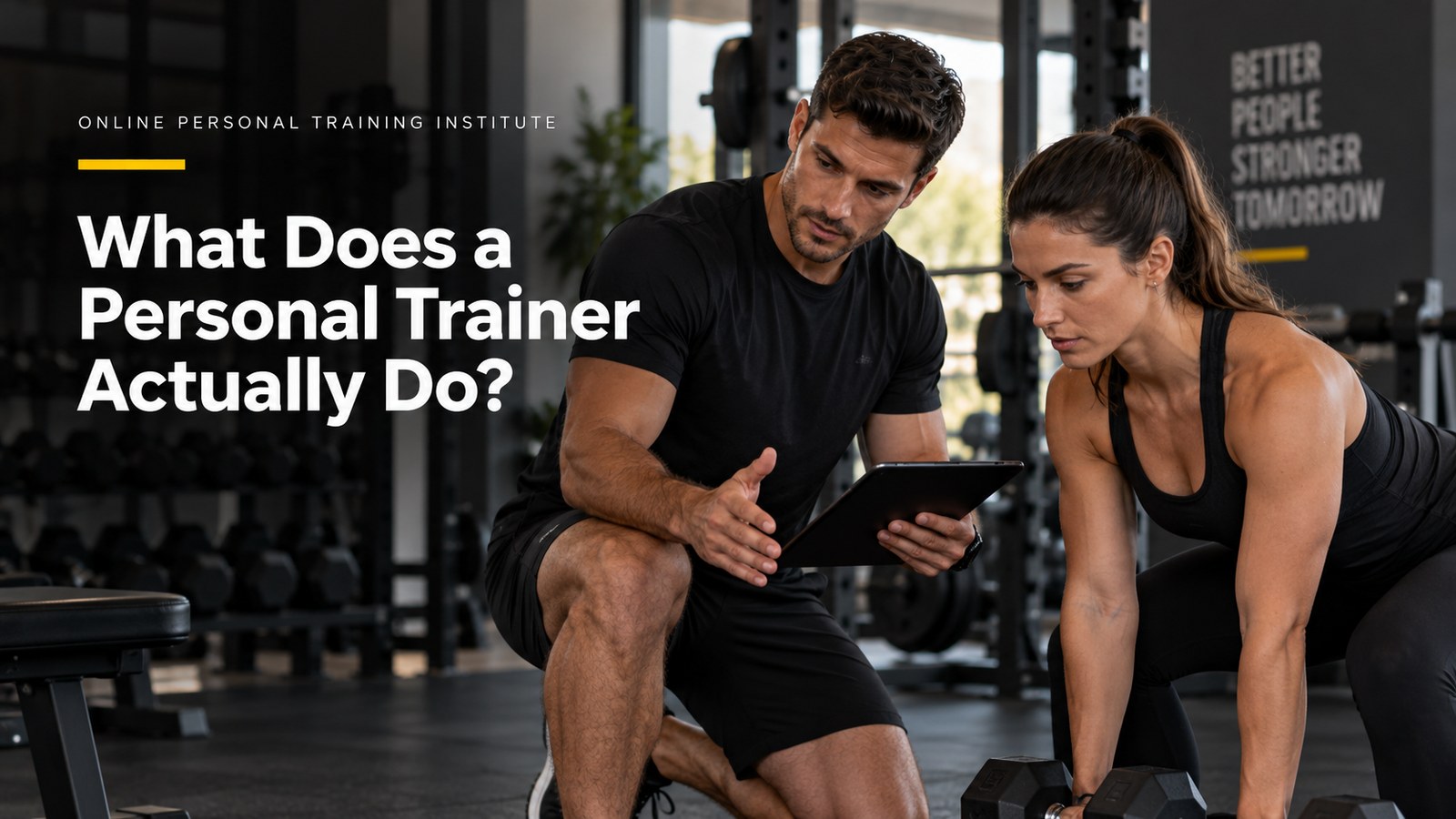
What Does a Personal Trainer Actually Do?

A personal trainer does far more than count repetitions. Good personal training combines exercise knowledge, planning, communication, observation, client support and professional judgement.
Personal training starts before the workout begins
A quality personal training session does not begin when the first set starts. Before programming exercise, a trainer needs to understand the person in front of them.
That can include learning about the client’s goals, exercise history, preferences, current activity levels and relevant screening information. Trainers then use that information to make appropriate decisions about exercise selection, session structure and progression.
This is one of the biggest differences between simply enjoying training yourself and learning how to train other people. Your own program only needs to suit you. A personal trainer needs to think about the individual needs of each client.
Designing personalised exercise programs
The SIS40221 Certificate IV in Fitness reflects the role of personal trainers who develop, instruct and evaluate personalised exercise programs for generally healthy and low risk clients.
Program design involves more than choosing exercises that look effective. A trainer considers the client’s goals, ability, training experience, available equipment, training frequency and how the program can progress over time.
The trainer then needs to explain the program clearly enough that the client understands not only what they are doing, but how to perform it safely and effectively.
Coaching technique and observing movement
During a session, a personal trainer watches how the client performs exercises and provides instruction, feedback and corrections.
That requires strong observation skills. A trainer may need to adjust an exercise, change the load, simplify a movement or alter the session plan when something is not working as intended.
Good coaching is not about making every client train exactly the same way. It is about being able to adapt while keeping the purpose of the session clear.
Helping clients stay consistent
Exercise knowledge matters, but knowledge alone does not make people consistent.
Personal trainers work with human behaviour. Clients can arrive motivated one week and discouraged the next. They can miss sessions, struggle with confidence or find it difficult to establish an exercise routine.
The Certificate IV includes skills related to supporting exercise behaviour change. In practice, this means communication, goal setting, encouragement and helping clients create realistic strategies that support ongoing participation.
Knowing when something is outside your scope
Professional trainers also need to recognise the limits of their role.
The national qualification describes personal trainers working with generally healthy and low risk clients, with higher health risk clients referred to appropriate medical or allied health professionals.
Being professional is not about pretending to have every answer. It includes knowing when a matter requires expertise outside the personal trainer’s scope and working appropriately with other professionals when required.
Where can personal trainers work?
Personal trainers can work in a range of settings. The national qualification identifies settings including fitness facilities, gyms, leisure and community centres, client workplaces, homes and outdoor locations.
Some trainers are employees. Others operate as self employed trainers. Some build a niche around a particular training style or client group, while others work with a broad range of general fitness clients.
The day to day environment can vary considerably, but the foundations remain similar: understand the client, plan appropriately, coach effectively, communicate well and evaluate progress.
Turning fitness knowledge into a professional skill set
Being passionate about training is a strong starting point, but professional personal training requires you to apply that passion to somebody else’s goals.
The SIS30321 Certificate III in Fitness builds foundational fitness instruction skills, while the SIS40221 Certificate IV in Fitness develops the higher level skills associated with personal training.
Online Personal Training Institute delivers both qualifications online with practical assessment requirements that allow students to demonstrate the skills they are learning.
If you are considering a career in fitness, visit onlinepti.edu.au to explore the available study pathways.
Ready to explore your fitness study options?
Explore the Certificate III in Fitness, Certificate IV in Fitness and Dual Qualification options with Online Personal Training Institute.